
Why Did My Peptide Reconstitute Cloudy?
Why do peptides reconstitute cloudy? Cloudiness after reconstitution has become an ongoing topic of discussion within some research communities. Cloudiness after reconstitution is one of the most discussed and controversial
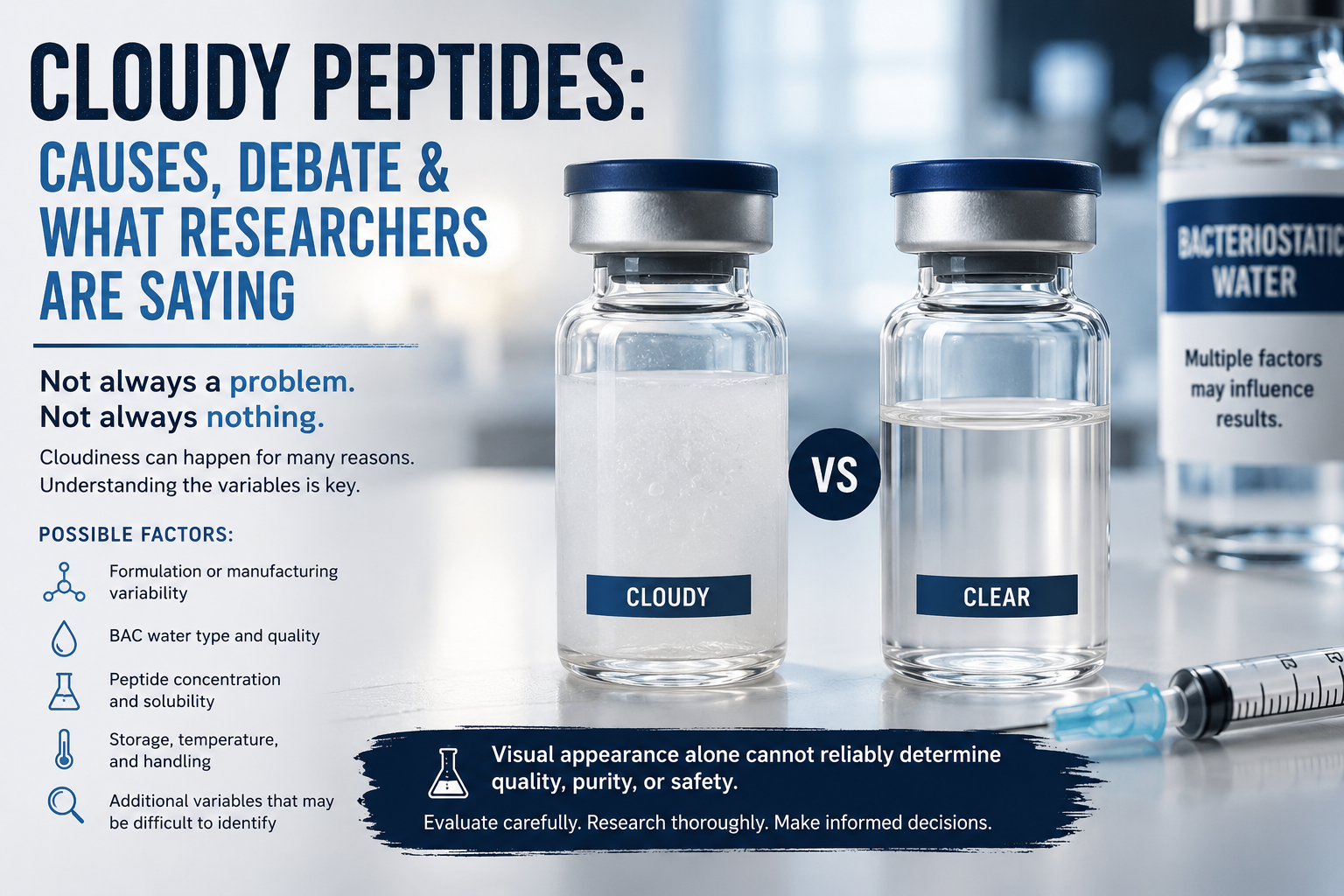
Table of Contents
Why do peptides reconstitute cloudy? Cloudiness after reconstitution has become an ongoing topic of discussion within some research communities.
Cloudiness after reconstitution is one of the most discussed and controversial topics in the research peptide space.
Within the research peptide community, cloudiness is often viewed as a warning sign. Many researchers assume a cloudy solution means the peptide may be contaminated, degraded, poorly manufactured, or negatively affected by the bacteriostatic water used during reconstitution.
The truth is likely more complicated.
Even extensive testing panels do not necessarily predict how every peptide formulation will visually behave after reconstitution. Tests such as identity, purity, sterility, and endotoxin analysis evaluate specific quality metrics, but they do not always account for every variable that may influence solution appearance.
In recent years, discussions surrounding cloudy peptide solutions have become more common across the research peptide space.
Researchers have reported cloudiness, gelling, or unusual reconstitution behavior involving a variety of compounds, particularly certain higher-concentration or more structurally complex formulations.
In many of these discussions, researchers typically debate whether the issue is related to the peptide batch itself, formulation or manufacturing variability, or the bacteriostatic water used during reconstitution.
Some researchers also report noticeable differences in reconstitution behavior between vendor-supplied BAC water and name-brand products such as Hospira. Others believe certain structurally complex compounds may simply be more sensitive to formulation and solvent variables than simpler peptides. Across research communities, users frequently report seeing:
- Hazy or milky appearance
- Floating particles or strands
- Slow dissolving powder
- Temporary cloudiness
- Solutions that clear over time
- Persistent cloudiness after mixing
This has led to ongoing debate over whether cloudiness is caused primarily by the solvent, the peptide formulation itself, manufacturing variables, concentration, or a combination of multiple factors.
What Can Cause a Peptide Solution to Appear Cloudy?
One of the biggest challenges is that cloudiness can result from many different variables.
Potential contributors may include:
- Solubility differences
- Peptide aggregation
- pH-related incompatibilities
- Residual salts or processing compounds
- Highly concentrated formulations
- Degradation or instability
- Formulation variability between manufacturers
- Particulate matter or visible contaminants
- Solvent compatibility issues
- Other unidentified variables
Visual appearance alone cannot reliably determine whether cloudiness is related to formulation variability, solvent compatibility, manufacturing differences, instability, contamination, or other factors.
This is one reason why discussions around cloudy peptide solutions often become so divided online. Different researchers may encounter similar visual results for completely different underlying reasons.
Are Some Peptides More Sensitive Than Others?
Many researchers believe certain peptides appear more sensitive to formulation and reconstitution variables than others.
This discussion is especially common surrounding newer or more structurally complex GLP-related compounds, including materials associated with retatrutide-related research.
Larger or more complex molecules may potentially respond differently to:
- Concentration levels
- Solvent conditions
- Residual processing compounds
- pH differences
- Manufacturing methods
- Formulation consistency
This does not automatically mean a cloudy solution is contaminated or unusable.
However, it may help explain why some compounds appear more frequently in cloudiness discussions than simpler peptides that often reconstitute clearly under a wider range of conditions.
Is BAC Water Always the Cause?
When cloudiness appears, many discussions immediately focus on bacteriostatic water.
Within the peptide community, Hospira bacteriostatic water is often viewed as the “gold standard” because of its established manufacturing standards and consistency.
At the same time, many researchers also use vendor-supplied bacteriostatic water products.
Some community discussions claim vendor BAC water is responsible for cloudy solutions, while others argue the peptide formulation itself is more likely responsible.
The reality is that both factors may potentially influence reconstitution behavior.
However, many researchers have reported seeing cloudy solutions occur even when using well-known name-brand bacteriostatic water products.
This is one reason some researchers believe widespread cloudiness tied to specific batches or formulations may point toward broader formulation or manufacturing variability rather than the solvent alone.
If the same peptide batch repeatedly appears cloudy across multiple users, different storage conditions, and different BAC water sources, the underlying formulation or manufacturing process may also deserve consideration.
Does Cloudiness Mean a Peptide Is Bad?
Not necessarily.
This is where the topic becomes highly controversial.
Some cloudy solutions may stem from formulation or solubility-related variables, while others may indicate a more significant issue.
The problem is that appearance alone cannot reliably identify which situation is occurring.
A cloudy solution does not automatically confirm:
- Contamination
- Sterility failure
- Endotoxin contamination
- Low purity
- Incorrect identity
- Unsafe material
At the same time, cloudiness also should not automatically be dismissed as normal or harmless.
A visibly abnormal solution should generally be approached cautiously, especially when the exact cause cannot be confirmed.
Why COAs Do Not Always Answer the Question
Another source of confusion in peptide discussions involves COAs and third-party testing.
Understanding third-party testing and COAs (Certificates of Analysis) can also help researchers evaluate product quality beyond visual appearance alone.
Many standard peptide tests focus primarily on:
- Identity
- Mass
- Purity
These tests are extremely important, but they do not always fully predict how a peptide formulation will behave once reconstituted in real-world conditions.
For example, a peptide may still pass identity and purity testing while researchers report unusual reconstitution behavior tied to:
- Solubility
- Aggregation
- Residual salts
- Formulation variability
- Concentration issues
Likewise, a cloudy solution alone does not automatically confirm sterility or endotoxin problems.
These are separate types of testing entirely.
Final Thoughts
Cloudiness in a reconstituted peptide solution does not always point to one simple explanation.
In the current research peptide market, multiple variables may influence how a compound behaves after reconstitution, including:
- Formulation methods
- Concentration
- Manufacturing consistency
- Residual processing compounds
- Solvent compatibility
- Peptide complexity
As discussions around peptide quality continue to evolve, balanced and cautious interpretation is often more useful than assuming every cloudy vial has the same cause.
A cloudy solution should be treated as an abnormal observation rather than automatically ignored or automatically assumed to be unsafe.
Some researchers attempt to reduce cloudiness by changing solvents, concentrations, or reconstitution methods. However, modifying formulation conditions may introduce additional variables and does not necessarily identify or resolve the underlying cause. Because peptide chemistry can be highly complex, significant adjustments should not be approached casually or treated as universally reliable solutions.
Because cloudiness can result from multiple potential causes, visually abnormal solutions should generally be approached with caution. Appearance alone cannot reliably determine whether a solution issue is minor, formulation-related, or something more significant. Researchers should evaluate materials carefully and make informed decisions based on the information available to them.
Frequently Asked Questions
Why did my peptide reconstitute cloudy?
Cloudiness after reconstitution may result from multiple variables, including formulation differences, solubility issues, concentration, solvent compatibility, residual processing compounds, or manufacturing variability. In many cases, appearance alone cannot reliably identify the exact cause.
Does a cloudy peptide automatically mean contamination?
Not necessarily. A cloudy solution does not automatically confirm contamination, sterility failure, endotoxin issues, or low purity. However, visibly abnormal solutions should generally be approached cautiously since cloudiness may stem from multiple possible causes.
Can BAC water cause cloudiness?
Some researchers report noticeable differences in reconstitution behavior between vendor-supplied BAC water and name-brand products such as Hospira. Others believe cloudiness is more likely tied to formulation or manufacturing variability within certain peptide batches. In many situations, multiple factors may be involved.
Does a COA guarantee a peptide will reconstitute clear?
No. COAs and third-party testing typically evaluate specific quality metrics such as identity, mass, purity, sterility, or endotoxins depending on the testing performed. These tests do not necessarily predict how every peptide formulation will visually behave after reconstitution.
Are some peptides more sensitive than others?
Many researchers believe certain higher-concentration or more structurally complex compounds may appear more sensitive to formulation and solvent variables compared to simpler peptides. However, reconstitution behavior can vary significantly between batches and manufacturers.
Should cloudy peptide solutions be treated cautiously?
Because cloudiness can result from multiple potential causes, many researchers choose to approach visibly abnormal solutions cautiously rather than assuming all cloudiness is harmless. Appearance alone cannot reliably determine the exact underlying cause.