
What Is a Certificate of Analysis (COA)? Definition & Purpose
A Certificate of Analysis (COA) is a document used across many industries to verify that a specific batch of a material has been tested and evaluated. In research settings, COAs
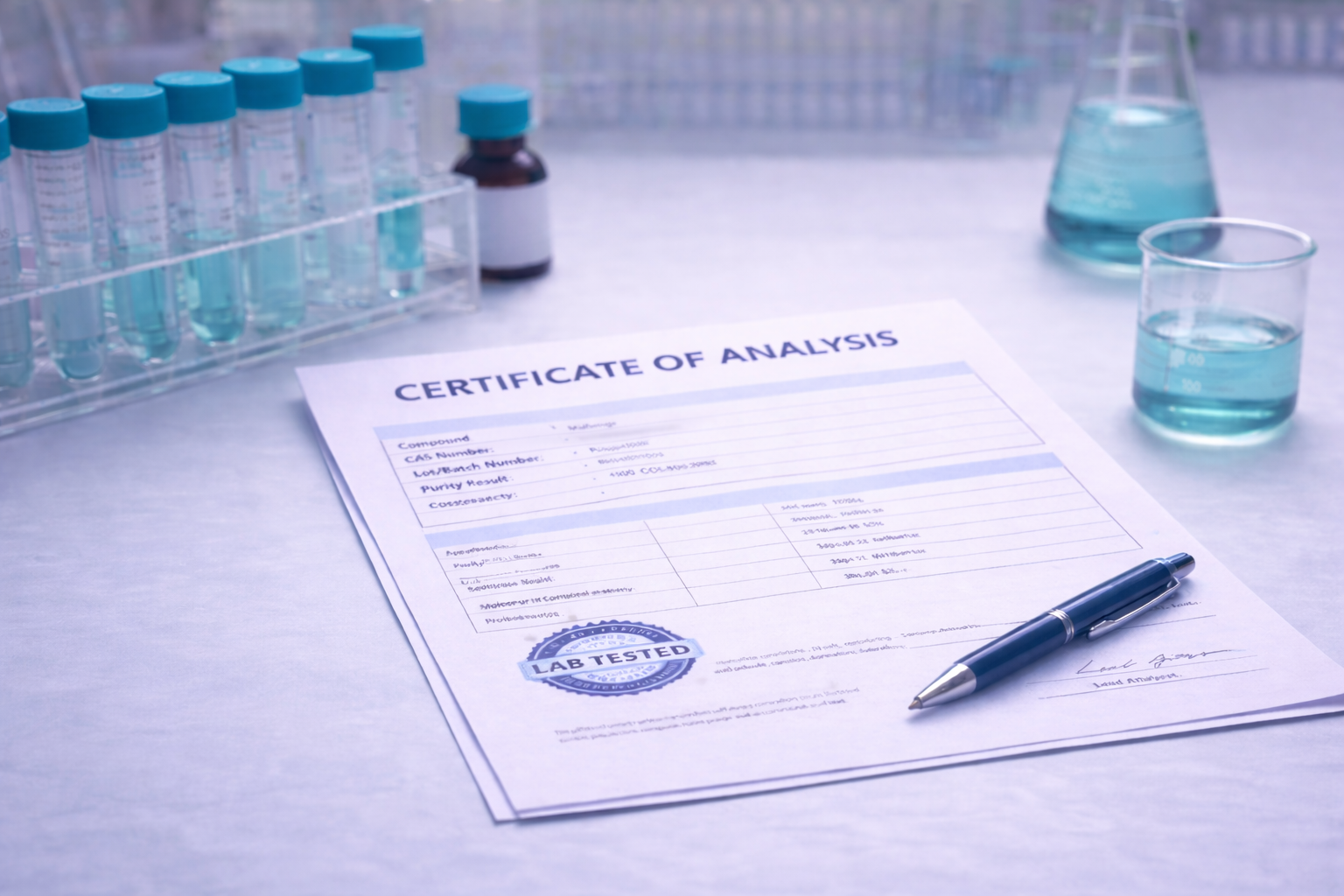
Table of Contents
A Certificate of Analysis (COA) is a document used across many industries to verify that a specific batch of a material has been tested and evaluated. In research settings, COAs help provide transparency into what was tested, how it was tested, and what the results showed.
If you’re new to COAs, this guide explains what a Certificate of Analysis is, what information it typically contains, and what it does — and does not — indicate.
For a step-by-step breakdown of how to interpret each field on a COA, see our guide: How to Read a Certificate of Analysis (COA).
What Does “Certificate of Analysis” Mean?
A Certificate of Analysis is a report issued by a testing laboratory that summarizes analytical results for a specific batch or sample. It is commonly used to document identity testing, purity analysis, and other quality-related measurements.
Each COA applies only to the exact batch or lot tested and should include identifying information that links the report to that material.
Who Issues a COA?
COAs are typically issued by:
- Independent third-party analytical laboratories
- In-house quality control labs
- Contract testing facilities
In research contexts, third-party labs are often used to provide an added layer of transparency and verification.
What Information Is Usually Included on a COA?
While the format of a Certificate of Analysis can vary by laboratory, most COAs include a limited set of analytical data related to a specific batch or sample.
Common elements may include:
- Product or sample name
- Lot or batch number
- Testing methods used (such as HPLC or mass spectrometry)
- Reported analytical results (such as purity or identity confirmation)
- Date of analysis
- Name of the testing laboratory
Some laboratories, including Janoshik Analytical, present results in a clean, summary-style format. These reports are designed to confirm specific analytical findings rather than provide extensive narrative detail.
(See examples on RT-20 (Reta) and RT-15 (Reta) product pages.)
What a COA Does — and Does Not — Measure
A Certificate of Analysis does not measure “potency” in the way that term is commonly used.
Instead, a COA typically reports analytical data such as:
- Chemical identity
- Purity percentage
- Presence or absence of specific compounds
A COA does not:
- Predict performance or results
- Guarantee consistency across different batches
- Indicate suitability for any specific application
- Measure biological activity or effectiveness
This distinction is important, as analytical purity alone does not account for all variables involved in research outcomes.
How to Read a COA
Once you understand what a COA is, the next step is learning how to interpret the data it contains.
Read our step-by-step guide here:
How to Read a Certificate of Analysis (COA)
Conclusion
Certificates of Analysis are an important transparency tool in research and quality evaluation. Knowing what a COA represents — and its limitations — helps researchers make informed decisions when reviewing analytical data.